Wednesday, May 08, 2013

Testing for Leakiness

Here we have a GooTube, purchased from EMS.
 
It contains Hot Sauce, an essential cooking element. Since it seems like a dicey thing to carry, testing it under pressure using a marble mortar and pestle seemed appropriate. Although if you squeeze it when empty, the air gets out/in, it shows no indication of leaking the hot sauce. It might not be trustworthy under the pressure changes experienced in the cargo hold of an airplane, so it will be placed in a ziplock pre-fight.

Tuesday, April 30, 2013

Glacier National Park and Logan Pass

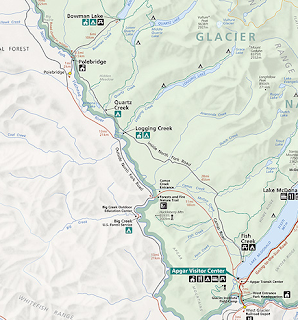
We were initially thinking about tackling the Going to the Sun Highway, which leads to Logan Pass.  Even though we probably are going to abandon this idea, due to time constraints, I thought I would post this.  I didn't find any information about cutting right to the Going to the Sun Highway from the GDMBR, so here is what I gleaned from a Glacier NP ranger.
GDMBR to Polebridge to Going to the Sun Highway
http://www.nps.gov/glac/index.htm
It is possible to continue down North Fork Road from the GDMBR.  The park service refers to this as the Outside North Fork Road, not to be confused with the Inside North Fork Road. The inside and outside refer to being inside or outside the park boundary.  This takes you into the town of Polebridge. When I asked him if it would be better to remain on the Outside or switch to the Inside, he concluded it would be better to stay on the Outside road, because it is much wider.  Both are dirt, the Outside taking more traffic. The disclaimer is that this ranger doesn't ride.  He noted that you might want a dust mask.
This route would probably take a day off route, as opposed to going all the way to Whitefish and then back into the park.
Anyone wanting to try this might consider calling the ranger station again for a second opinion on Outside versus Inside.  Either way, you end up at the south end of McDonald Lake, the start of the Going to the Sun.  The two campgrounds closest to the pass are Sprague Creek and Avalanche Creek, but I think he said the last place for food was at the Apgar Visitor center.  From one of the campgrounds, you could go up to the pass and back down. The distance from the breakoff to Polebridge, to Apgar visitor center and the top of Logan Pass, then backtracking and moving on to Whitefish is about 118 miles.  The straight GDMBR from the same breakoff directly to Whitefish is 49 miles and of course Logan Pass is all up, but not steep. If I interpret this document correctly, the grade does not exceed 6%.

Such excellent questions lately...

A couple of people have approached me lately asking about bicycles or bicycle travel.  This made me think about how to approach the answers and what resources are out there for people interested in starting out in cycling.

Question: I am interested in touring.  What kind of bike do I need?
Answer: This depends on what you can afford and are willing to put up with.  I know several people who rode really old (but originally high quality) bikes across the US.  The disadvantage is that anything with 27" wheels and a 5 cog rear hub will be more difficult to buy parts for.  In addition, the parts it has will probably be older and more worn, and more prone to breakdown.  Also, someone younger or with really sound knees might not care about the gearing, but those of us who are older generally need to be gentler on our knees, so the gearing becomes more important.  Get the best bike you can afford.  Apart from a dry tent, it is the single most important piece of equipment you will need.
Racing bike
ScottSpeedster, CC Flickr user Zacke82

Question: Should I buy a bike online or from a bike shop?
Answer: If you know a great deal about bikes, their components and what you want, you can probably get what you want online.  But if you are reading this post, I would think you are more my type: I want to ride a bike that will last and be comfortable.  I have bought both of my new bikes (as well as my very first used touring bikes) from bike shops. Don't bother with a chain store, if you can avoid it.  A local bike shop should try to sell you the bike you need, not something more. A local bike shop will rely on you being happy and coming back for accessories and tune ups.  Make sure you can answer some basic questions before you walk in.  A friend asked me what she should get and this is the list of questions I posed her:

  • What will it be used for?  Commuting? Recreation? Going really, really fast? (this will help determine how heavy a bike you can accept- the material it is made up of...)
  • Do you only ride in sunny, warm weather? (no need to worry about fenders if the bike won't be out in the rain- fenders require a frame that is wide enough to accept them, i.e. not racing bikes)
  • Will you carry things on it?  Just a repair kit or water bottles or a rack/bags? (This will help determine if the frame needs attachment points for those things)
  • How far do you expect to go on the bike?  Just a few miles or 30 miles in one instance? (this helps determine whether you will want to be more upright or more stretched out)
  • touring bike
    Surly LongHaulTrucker Touring Bike,
    CC Wikimedia Commons by insidestory
  • How tough is your butt?  Do bumps annoy you? (this will determine if wide or skinny tires  and suspension/springs are appropriate)
There are 3 main categories of bikes: racing, touring, mountain.
Racing bikes are light, with skinny tires and are not meant to carry things
Touring bikes have beefier tires and you can attach fenders, racks and other stuff
Mountain bikes lessen the bumps with wide tires, sit you more straight up and can often carry stuff
mountain bike
Cale, CC Flickr user k.streudel

*all generalizations are false (quote courtesy of my daughter)

Hybrid bikes are a mix of touring and mountain.  They sit you up higher, but tend to not have all the shock absolution of a mountain bike.

Generally bike shops are licensed to carry only a few brands.  Most likely there will be something in one of those brand's lineups that will make you happy.  If you are dead set on a specific brand, find a bike shop which carries that brand.  I preferred to answer the above questions and then take the answers to the bike shop.  I told them what I needed, gave them my max spending limit and let them dwell on it.  They go to shows and flip through catalogs all the time.  They know the components.

Oh.  One more thing.  Support your local bike shops.  You want them there when you need them, right? The price difference is usually less than 2%.  And there is a big difference between a Walmart inner tube and one from a bike shop.  Walmart tubes are only good for one thing, getting you to a real bike shop.  Well, maybe not even that.  Depends how far it is.

Saturday, April 27, 2013

Test of posting.

This is test of the android blogger app. The app worked well.  Not a lot of flash in the pan, but it allowed me the rudiments of blogging, including pulling in images from the photo gallery.

Monday, April 08, 2013

Shake Down Efforts

After loading up my bike and taking it out in a city park near my home, I decided that I rattled so much, there would be no need for a bear bell. To remedy this, I put vinyl tubing on the rear rack and wrapped the front rack with electrical tape and inner-tube at the point of contact with the panniers to take up the extra space in the pannier hooks. I also created a mounting bracket to bolt to the top of the front rack for a headlight. Fenders may elude me, for I can find no acceptable way to mount one to my suspension fork.  The rear tire needs one less, for the rear rack will take most spray. I have also been combing the stores to find foods which might be procured while on the GDMBR, to see how they might be seasoned, how much they make per cup of dried, whether reducing the required water has much impact, whether not draining noodle dishes is possible and whether dehydrated vegetables and mushrooms were practical. More on this in the Vermont Report.
I ventured to Vermont for 5 days to meet up with a friend and try out our gear for the GDMBR.  It was colder in Vermont than Buffalo, so my plan to spend the first night near Killington in Gifford State Park, in the Northern portion of Green Mountain National Forest, was unsuccessful.  There was still quite a lot of snow on the ground and temperatures were expected to drop to 18 degrees.  Instead I slept in a church parking lot on the West side of the park at a much lower elevation. It still dropped to about 27 degrees, but the car served as a bit of a buffer.  Note that I was still cold in my 15 degree bag on my original Thermarest, sleeping on a board suspended between the rear seat and a milk crate; ie, there was just air beneath the board. Inside the bag, I kept my Foxwear tights and Patagonia R1 fleece on, with a hat, gloves and heavy wool socks.
The next morning I tried to cycle around Chittenden Reservoir, but snowmobiles had packed the snow on the trail such that 95% had to be walked. I turned around after about 1/2 mile.
My next excursion was to return to Rutland, where volunteers have worked on the Pine Hill Park to make it a mountain bike haven.  I only spent about 1 hour there, but was quite thrilled to have such a beautiful asset available.  Pine Hill could occupy almost a full day of mountain biking. For me.
When I met up with my friend, Jamie, she began by taking me out to kill me on frozen roads.  Unfortunately whenever I see a new opportunity for taxing my rather poor mountain biking skills, I always accept fate and charge ahead. Twice I went down due to getting caught in frozen ruts.  The nice thing about crashing on ice is the total lack of road rash. You can come away with some fabulous bruises, but the ice tends to be kinder to both rider and bike.  Two things I took away from those crashes: the Patagonia down sweater did tear or show any signs of abuse, even after I decided to roll over and lie on my back as I was sliding down the hill, using it as a sled, and the extra long skewer used with Old Man Mountain rear panniers, should be cut off so it does not protrude beyond its knob.  When I got home and tried to first bend the 3/4 inch extension back and then use a hack saw to remove the bent portion, failed catestrophically. The skewer is so bent that the outside plastic of the skewer's knob broke away from the metal nut inside.  When I used vise-grips to get the nut off, the skewer was still so bent, it can not be pulled through the axle.  I will have to cut off the skewer further, thereby totally ruining the skewer. A new one is $18. Sigh.
One of the foods we tried at Jamie's house were quinoa, into which we mixed dehydrated vegetables and dried mushrooms I had powdered.  The 2 tablespoons of mushroom powder were un-noticeable, and the vegetables would required us to carry large quantities, since the chance of resupply would be slim. Next we tried a vegetarian chili mix, into which we mixed a can of beans and tomatos. Canned goods are good if you don't have to carry them far, but 2 cans for one meal gave us too much food for one sitting.  Maybe a can of beans and a tiny can of tomato sauce.  We put the resulting chili on tortillas and ate it as burritos.  The vote: forget anything we need to carry in its entirety from the beginning (dried veg), tortillas are fabulous (already knew that) and spices/hot sauce would be valuable.
We picked up Jamie's new Surly Ogre and waited while a great mechanic at Onion River Sports configured the bike and attached various parts, including a rear rack.  Fully equipped, we headed back for Green Mountain National Park.  A ranger had done a little research for me to find winter camping opportunities and trails open to bikes, but not to snowmobiles. Silver Lake CG is accessible from a trail head near Branbury State Park.  A one mile closed road takes you up to the CG, closed to motorized vehicles. There were a couple of icy patches, which were difficult to get over/around, but less than 10%  of the road was in that state. More of the road had soft, previously frozen slushy old snow.
We got up to the CG, scoped it out a bit, then pitched our tents in the host site. Dinner was two of those Lipton noodles and sauce meals.  It was nice to have a hot meal, since the temperature was dropping quickly. We cut the liquid requirement of the Lipton meal by half and it was still great.  We also boiled it and then turned it off, covered.  Still fine.
At around 7pm, we jumped into our tents, because the temperature was dropping so precipitously. At about 10pm, I told Jamie that if SHE wanted to go back to the car, we could do so at any time.  Needless to say, I was voicing my own worries.  Even with all the clothing I brought (minus my rain pants) I was cold in my 15 degree bag.  I don't know exactly how cold it got, but might guess 27 degrees, since that was what was forecasted.  On several occasions in the night, I woke up and had to rock myself to produce heat to keep warm.  When sleeping, I was warm enough.  Jamie apparently had similar problems; we were in two tents and climbing into one would have been our next resort.  We agreed that one major problem (believe it or not) was that when we slept in all our clothes, we had nothing to use as a pillow and this caused us enough discomfort to keep us awake at times.  Maybe if we had been pedaling all day, we would have been tired enough to just collapse without a pillow.
We did make it through the night, but jumped out of the tents as soon as it started to get light and went for a warming walk.  We had to break through ice at the edge of the lake that the evening before had been open water.  The walk down was now treacherous, because all of the slushy snow had frozen and unrideable. Not only was it unrideable, but it was slick and for many parts we had to bushwack through the woods with fully loaded bikes to get around sheer ice.  Only a mile. Only a mile. Only a mile.
We spent the rest of the day at Pine Hill in Rutland; dry, warm, fun.  While Silver Lake gave us a chance to test out the camping side, Pine Hill gave us a chance to try out our bike setups (without panniers). I got many chances to fall off and Jamie and I swapped bikes to see how the other half was living.  Her Ogre has 29" wheels and no suspension.  My Troll has 26" wheels, a thudbuster seat post and shock fork.  Some observations: the 29" wheels make the front suspension less necessary (but I would still want it) and probably negate the need for the Thudbuster seat post. You sit higher up on the Ogre (further for me to fall- can you believe she let me ride her brand new bike, given my history?). She has flat bars and I have butterfly bars- I didn't see any advantage either way. She has a very small tolerance between her front derailleur and tire- not sure it will ever matter.  I bought my bike thinking 26" tires are more common worldwide, but 29" are gaining ground.  In 3rd world countries, it might still matter...  Final thought- two excellent bikes.
Lastly, I will broach front lights.  I had made the mount for my light, but the guy at Onion convinced me to get a headlamp.  I have often thought of this, but didn't want to carry 2 lights, one for the bike and one for my head.  He presented a slight alternative.  Tiny LED front and back lights, which are amazingly bright and would be adequate for letting people see you.  They are light and require very little battery power. AND a headlamp for reading or doing night tasks.  Forgot them for Silver Lake, so I haven't tried them out, but I have faith...


Wednesday, March 20, 2013

Banff Airporter

The Airporter is a shuttle service which travels between Banff and the Calgary airport.  The questions I asked them on the phone today:

Q- How many boxed bikes can one shuttle accommodate?
A- As many as there are passengers with boxed bikes. If there is not enough room in the shuttle, they send the bikes on the next shuttle to your doorstep. Shuttles run between 1-2 hours apart.

Q- How far in advance should we book a shuttle for a July 2nd airport arrival?
A- Mid-June should be fine

Saturday, March 16, 2013

More GDMBR planning- 3 months left


 The companions wanted ads finally did work.  Two gentlemen who need to start separately connected with me.  One wants to do the Canadian portion, but won't travel alone, a wise decision. To my great joy, a friend of mine has decided to jump into the fray.  My plane ticket has been bought.

Some thoughts on the McCoy book: I am not sure it is as important along the ride as the maps, but the truth will tell after I start. He offers great advice on first aid equipment and some details about other equipment. Maybe I will pull out the pages I want.
The Surly Troll now has racks front and back.  The Ortlieb panniers needed to have larger spacers exchanged (larger spacers came with them).  The diameter of the rear and front racks are different; no spacers are needed on the back. Both racks are Old Man Mountain Pioneers, I believe.
Here is a photo of the Surly almost fully loaded. Missing are the Teva sandals I just ordered and some small toiletries. The bags weigh 34lbs 10oz.

There is a shuttle from the Calgary airport to Banff and Canmore, so you can stay either place. As of this writing, the shuttle has extensive hours and takes 2.5 hours. We will probably stay at the YWCA hostel for 2 nights, which appears to cost $300 for 2 double beds w/out a private bath.  This would allow us to assemble and load our bikes under a roof, something which is not available if you use the campground in Banff.
To add to my equipment, I purchased a used Pategonia Down Sweater, which compresses very small and a pair of Teva Churn watershoes.  The watershoes are an attempt to replace my Keen sandals, which function really well, but take forever to dry and are heavy.  I will add an equipment review of them after they arrive and get a workout.
The fender problem still exists, but hopefully the local bike shop has some thoughts on this.  They are a pretty creative group.

Tuesday, February 12, 2013

The Snowstorm Challenge

Buffalo had quite a little snowstorm recently.  Four people were astonished I rode the whole 3 miles to work regardless of the forecast and two more offered me a ride home, but slow and steady makes the grade.  For those out there contemplating riding in moderate snow, there are a few things to consider.
Studded tires are a waste in anything but ice and even then they are not 100% helpful.  You still go down on the ice, but since you slide, there is no road rash and fewer bruises.  You can't go nearly so fast, so even if you strike something, it is not a big deal.  The most important things are to not take chances turning in front of cars or being on streets where if you go down you might be hit by a passing car. The cars take a long to stop and on ice, they don't swerve very well.
That is a 15lb bag of cat food on the back rack for traction.  Just kidding about the traction.

Monday, January 07, 2013

GDMBR planning

I posted an ad for companions in both Adventure Cycling and CrazyGuyonaBike websites.  The responses have been far fewer than when I posted for the TransAm, but maybe that should not be surprising considering the two are vastly different.

Here are the steps so far:
  • buy the McCoy guide book
  • buy a mountain bike
  • buy the maps from AC
  • post the companions wanted ads on Crazyguyonabike and Adventurecycling
  • look in the forums for guidance on getting myself and my bike to Banff
  • look for a 800 fill used down jacket
  • look into how I will cover my shoes if it is cold or cool and raining
  • figure out how to attach a fender to my front fork (it has suspension and a rack attached)

The trail begins right in Banff, behind a hotel that has changed its name.  Currently it seems to be called The Fairmont Banff Springs. There is Canada Parks campground called Tunnel Mountain at the edge of Banff. They have two areas, one which seems to be full hookups and one with no hookups. In addition, many sites are first come, first serve and there are also a few walk in sites (probably last to fill).  For cyclists, the parks department notes that except for three day holidays, it should not be a problem arriving without a reservation (for those of us who have no idea when we will be arriving). I thought all Canadian campgrounds had a policy of "no refusal" for people arriving without a vehicle, but now am not so sure. BTW July 1 is Canada's Independence Day holiday.
As for getting from the Calgary airport, racers suggest that you take your bike with you on the plane and use Banff Airporter shuttle service to get to Canmore or Banff. Racers seem to glow with enthusiasm about this service.
The links I have collected about the GDMBR and related stuff is located here.

Sunday, December 02, 2012

Cranksgiving in Buffalo

New Event Alert!


Hopefully this will occur annually, but GO Bike Buffalo helped Buffalo join other cities in the nation to collect food for food pantries, community outreach centers and such.  This year the collected items went to Food Not Bombs, an organization that prepares a meal and distributes it en masse from a central location.

Some participants took the event with a grain of salt (ha, ha, ha, ooh, ok, stop) and cruised around at a leisurely pace, while there was also a group which came in unibody team spandex and were obviously out to win.  Our little group of three took the middle ground. If you look in the above photo, you will see our bikes lying on the ground (note the red panniers), so that all those people running had to leap over our bikes and then carry theirs out of the middle of the pile, effectively slowing them down. This is what our little group called "strategy".  Poor Jason, one of our group members.  I think he has a competitive streak in him, which we frustrated.

The objective of the event was to go to three checkpoints and five grocery stores and buy at least one item on a list from each store.  Keep in mind that you had to carry it all using your bike/body and that the items included canned goods and 5lb bags of flour.

The middle checkpoint required arrivals to use their hand to make a crayon turkey drawing, do a shot of Wild Turkey (actually optional) and write about what you were thankful for.  The end point was the GO Bike workshop, complete with beer and really nice volunteer made food.  Shout Out to GO Bike Buffalo for making this happen and showing us how to have a good time.  BUFFALO, BUFFALO, BUFFALO! (Portland, OR did not participate- hear the taunt)

The Small City Advantage

Buffalo is a small city.  There is almost nothing that is not highly accessible to cyclists.  It is with great joy that I am and more frequently surrounded by people who are not afraid to hop on a bicycle to meet up.  On this occasion, 3 separate small groups all showed up for breakfast on bicycles.  While two of them are without cars, the other three all chose to go by bike anyways.  And I was out on the commercial strip (don't read that as stip mall or chain store alley, but a strip of bona fide independently owned small businesses) IN MY CAR, on the way back from a "carry something huge" errand and found myself in a gridlock of car traffic. It struck me suddenly that I rarely experience this frustration anymore. On a bike, I would have passed all of the cars (carefully) or not been on that street riding at all.  There is such joy to be found in life.

Saturday, October 20, 2012

Surley Troll

Thinking, planning, scheming.  The Great Divide Mountain Bike Route (GDMBR) is on my horizon and as such a new bike was in the equation.  My LBS, Campus Wheel Works, kept me in their sights for almost a year, looking out for a bike that would perform well in a wide variety of settings.  The GDMBR is comprised of single track (one lane dirt trail), double track (old roads), dirt roads and pavement.  Trying to find a bike to cover all aspects of this trail and carry panniers or tow a trailer is a challenge.
In late August, Ethan pointed me towards the Surley Troll, a hybrid/road/mountain bike which is able to morph into many different things, due to the multitude (ooooh- I've used that word twice today) of dropouts and braze-ons.  This configuration allows Rohloff hubs, which contain internal gearing to take the place of a derailleur, disk brakes, cantilever brakes, fenders and racks. Ethan poked around until he found a front suspension fork which could accomodate a rack (something mountain bikers would generally frown upon). I will miss using the really cool OEM fork, which has braze-ons for water bottle cages on the outer edges, along with braze-ons for anything else you can think of. The price tag comes to under $2,000, which is still a whole heck of a lot of money to me.
There is now a Thudbuster seat post on it and pedals which will accomodate Power Straps.  It seems like the Power Straps will outperform cages and give some of the advantages of clipless pedals without the special shoes. Addtionaly, it has a King water bottle cage and a new fangled Camelback bottle, which doesn't leak when turned on its side.
Now the bike just needs a rear rack and better reflectors and/or lights.  Here is a wonderful resource on tail-lights.  So sweet when someone does my homework for me and does it well.
 Oh, and when I asked about the dreaded "chain slap" which occurs when the derailleur can't absorb the slack caused by going over big bumbs, Ethan suggested a Cycle Stuff Chain Stay Wrap, which will probably be more durable than a cut up tube. I think the handlebars are Multibar Butterfly bars.  They should offer up a nice variety of hand positions for all the washboard road along the GDMBR.
I will be aiming for the summer of 2013, unless Adventure Cycling calls me to lead a tour, in which case I will gladly shift gears.

Review:
This is the first mountain bike type bike I have ever owned that was sized properly.  It rides smoothly, with the Thudbuster taking some of the jarring out of the rear without the weight of a full suspension. The fork (Rockshox) seems to offer a nice balance of absorption and has the ability to lock the suspension.
The rack is an Old Man Mountain and came with several options for mounting, but is designed for a suspension fork.  The disk brakes on this bike will help with the brutal braking conditions the bike will be subjected to, carrying a full load of panniers, water and me. Mud and water have affected every touring bike I have used, but this bike will see more mud than on a road tour, though not necessarily the downhill speeds seen on a road tour. I thought the tires would be too much for roads and not enough for of road- wrong: pretty good all around.

Two irritating things- the front derailleur cable comes out diagonally, impeding my ability to grab the bike and carry it by the seat tube up/down stairs and that same derailleur's clamp is placed between the two water bottle mounting points on the seat tube, necessitating the use of spacers (which it didn't come with) to attach a cage.

Thursday, October 11, 2012

Progress runs in jagged lines

So in September there was a big hoopla because the city planned something wonderful and forward-thinking, but totally failed to ask anyone for input, basically guaranteeing that an entire neighborhood would revolt. Two way bike lanes on a one way street- Linwood Avenue
Sharrows on Elmwood Avenue
First came the repaving of the street.  Then came the lights facing the wrong way down a one-way street.  Then came the uproar as the neighbors tried to discern what was going on. THEN came the city discussion with the neighbors.  A very jagged line indeed.  In defense of the city, the DPW did actually ask someone about bikes and bike lanes who had some education on the topic.  And that person DID send them to a very good source for information and they DID follow a best practice model.
Outcome?  A set of bike lanes supplanted one of the north bound car lanes on this one-way street. It's also had the effect of slowing traffic that was out of control. And this seems to have set off a plethora of bike related efforts.  It does seem that at least some has been in the works for a while.
And for that fool who asked, "Why a bike lane to nowhere?"; build it and they will come.  The day the city striped it, there were already cyclists riding it who would never have ridden the wrong way before.