


Thursday, July 19, 2012

Wednesday, July 18, 2012
Netherlands July 18
 The bed was soft, but someone had left the window open a smidgen and two Mosquitos had made it in. The first managed to bite me and woke me up, then kept me awake while I tried to kill it.
In the morning, I was awoken quite close to breakfast time by the B&B owner gathering the breakfast stuff together. Hadn't thought I would sleep in, so I had not set an alarm. I took advantage of the fabulous photo op from the third story window, taking in the rooftops and the cool view.
Breakfast was an intriguing variety of stuff, from the more mundane scrambled eggs to two chocolate waffle crisps with honey between (stroop waffles). We also had crepes, to which I added real chocolate shavings the Dutch call "sprinkles", not to be confused with the junk Americans call sprinkles. There was also yummy butter, warm rolls and local cheese slices. We retrieved our bikes from the hidden garden type alley behind the houses, where they had been locked overnight.
The bed was soft, but someone had left the window open a smidgen and two Mosquitos had made it in. The first managed to bite me and woke me up, then kept me awake while I tried to kill it.
In the morning, I was awoken quite close to breakfast time by the B&B owner gathering the breakfast stuff together. Hadn't thought I would sleep in, so I had not set an alarm. I took advantage of the fabulous photo op from the third story window, taking in the rooftops and the cool view.
Breakfast was an intriguing variety of stuff, from the more mundane scrambled eggs to two chocolate waffle crisps with honey between (stroop waffles). We also had crepes, to which I added real chocolate shavings the Dutch call "sprinkles", not to be confused with the junk Americans call sprinkles. There was also yummy butter, warm rolls and local cheese slices. We retrieved our bikes from the hidden garden type alley behind the houses, where they had been locked overnight.
It took a little circuitous travel to get out of Gouda, since there is a lot of industry surrounding it and several highways. Very high winds forced us to draft a bit, but with the trailer, I am unable to contribute. Delft was a beautiful town, and large. We ate lunch at a bakery chain. Everything is an experience. I could look and point, but the menu was unreachable. There were not enough cognates and I don't know Dutch. Sara tried to help us, but there were three of us who didn't know Dutch and only one of her. She really is extremely sweet and things would be much more difficult without her. Delft reminds me of Cork, Ireland.


We didn't visit the Delft factory, but the reputation and references to the style were obvious. (At the end of the trip in Amsterdam, the Rijkuseum had a small exhibit on the origins of Delftware).


Entering De Haag, Sara led us pretty confidently, because she has friends here.

 |
| Entry to Parliamentary Bldgs |
We walked through the parliamentary buildings, where she pointed out that the members of parliament regularly ride their bikes to work, just like everyone else.


 A little further on, we were greeted by the ocean after a rise. Wonderful humorous bronze sculptures welcomed you, including a cartoon "Little Dutch Boy" trying to plug a leak, which was basically a fountain.
The bike path along the ocean was parklike, traveling through old dunes. We came across this sign. I burst out laughing. The "LET OP!" part I knew was "look out" or something akin to that, but the rest totally baffled me. Later I asked Sarah about it and she told me it was something like "wet cattleguard". There were several long running references to glad wildroosters hereafter.

Then came the rain, cold and wind. The wind was welcome, because of our mostly northern travels.
Not much further on up the coast, along a dune path, we came to our campground. The sign here said "Camera Bewaking". We finally had a chance to try the Dutch version of French fries, which are served with a type of mayonnaise. Not bad. The showers and laundry I found confusing, but if I had just thought them out a little before hand I probably would have figured them out. For the showers, you had to insert the money before you entered the shower room...
Tuesday, July 17, 2012
Netherlands July 17


 There was a witch weighing house in one small town (Woerden, I think). If you weighed too
little, you could fly and thus were a witch.
We ate lunch at a sidewalk cafe, scarfing yummy sandwiches, and I tried
to buy a raincoat at a bike shop. Only problem is that many stores will
not accept my credit card, because there is no chip in it. I had managed
to get a card without a foreign transaction fee, but alas no chip.
There was a witch weighing house in one small town (Woerden, I think). If you weighed too
little, you could fly and thus were a witch.
We ate lunch at a sidewalk cafe, scarfing yummy sandwiches, and I tried
to buy a raincoat at a bike shop. Only problem is that many stores will
not accept my credit card, because there is no chip in it. I had managed
to get a card without a foreign transaction fee, but alas no chip.Some prankster had cut apart a pair of rain boots and put them on the feet of a statue of a girl. Pretty clever, since they had to make laces up the backs. It was really a double take moment, before you realized they were not supposed to be there.


Along the canal, boat traffic moved in both directions. Some appeared to be commercial, but most was recreational. At intersections, there were still old streets signs, though many were very low and difficult to see.

Gouda is laced with canals and often the front yard is accessed via a bridge across one.

We stayed at a B&B in Gouda, which has small quaint rooms. Mine is on the third floor and has almost a ladder rather than a staircase, it is so steep. We grabbed items from a grocery for "dinner" and tasted some of Linda and Sara's Old Cheese, after walking around town a bit.
Here is the view from my rooftop window (the window is similar to the one on the house across the street)


Monday, July 16, 2012
Netherlands July 16
I left at around 5pm Buffalo time. The flight is about 8 hrs, but travels back 6 time zones. This puts me in early the next day. Last night I deliberately slept for only 4 hours, so sleeping on the plane would be less difficult. I watched one movie and then slept a bit, on and off. This flight has many empty seats and the one next to me was empty, making sleep much more comfortable and likely.
We passed a huge thunderhead spewing lightning, which towered above the surrounding cloud bank but we were above and to the side of it. For the most part there is a continuous carpet of clouds below us, with some beautiful thunderheads, which we were above.
Windmills near Windsor, Ontario and again in France maybe, an oil rig off the coast of Holland. The clouds below us over the ocean were distinctly cotton candy pink, even though we were long past dawn.


 Bill managed to find me right off and gave me my first lessons in cycling in the Netherlands. It started raining as soon as we left the airport and never stopped, though at least it was about 60 or 65 degrees.
There are roads where the two way car traffic gets only one lane and the cyclists get two. And the cars have to wait if there is not room for all to pass. The drivers scare me sometimes, because they are forced to pass so close, but they are used to it and there is no maliciousness.
Flying overhead it had looked like there were pastures without fences, ditches serving that purpose and while cycling around, it was clear that the ditches are quite effective for that purpose.
Arriving in Utecht was an eye opener, since the first sight you come across is the red light district. Little rooms perched on the edge of the canal, about two in a space equivalent to a shipping container, the women show their wares through picture windows with red neon down the sides. They all had on bras and underwear and weren't terribly risqué, but most were talking or looking at their phones. It is unclear whether they are engaged in sex chat or talking to friends or just surfing. Just a little further down the canal, beautiful canal/house boats line the edges. We have seen several windmills already. It appears there are only 900 left, but they are heavily protected. It is supposed to be as difficult to run them as to pilot a ship.
We arrived in Utrecht quite soaked and searched for the hostel and then a specific hotel, but finally gave up in exasperation and took a pretty pricy hotel. We dried our clothes on the heating registers successfully. Utech isn't especially lovely downtown, mostly owing to the massive railway station construction going on, the rest owing to the rain and grey. Thousands of bicycles are parked on every permissible surface.
Bill managed to find me right off and gave me my first lessons in cycling in the Netherlands. It started raining as soon as we left the airport and never stopped, though at least it was about 60 or 65 degrees.
There are roads where the two way car traffic gets only one lane and the cyclists get two. And the cars have to wait if there is not room for all to pass. The drivers scare me sometimes, because they are forced to pass so close, but they are used to it and there is no maliciousness.
Flying overhead it had looked like there were pastures without fences, ditches serving that purpose and while cycling around, it was clear that the ditches are quite effective for that purpose.
Arriving in Utecht was an eye opener, since the first sight you come across is the red light district. Little rooms perched on the edge of the canal, about two in a space equivalent to a shipping container, the women show their wares through picture windows with red neon down the sides. They all had on bras and underwear and weren't terribly risqué, but most were talking or looking at their phones. It is unclear whether they are engaged in sex chat or talking to friends or just surfing. Just a little further down the canal, beautiful canal/house boats line the edges. We have seen several windmills already. It appears there are only 900 left, but they are heavily protected. It is supposed to be as difficult to run them as to pilot a ship.
We arrived in Utrecht quite soaked and searched for the hostel and then a specific hotel, but finally gave up in exasperation and took a pretty pricy hotel. We dried our clothes on the heating registers successfully. Utech isn't especially lovely downtown, mostly owing to the massive railway station construction going on, the rest owing to the rain and grey. Thousands of bicycles are parked on every permissible surface.
 On a separate note, Bill got 2 free pieces of luggage, though he only used one and brought his boxed bike for $50 via Icelandic air, while I only got one piece of checked luggage and had to pay $80 for my second piece (that being my bike in its suitcase). He may have gotten a better deal, depending on how much he paid for his ticket. He threw out his cardboard bike box and will buy another for the return trip (I think maybe he said he can buy it from the airline for about $25).
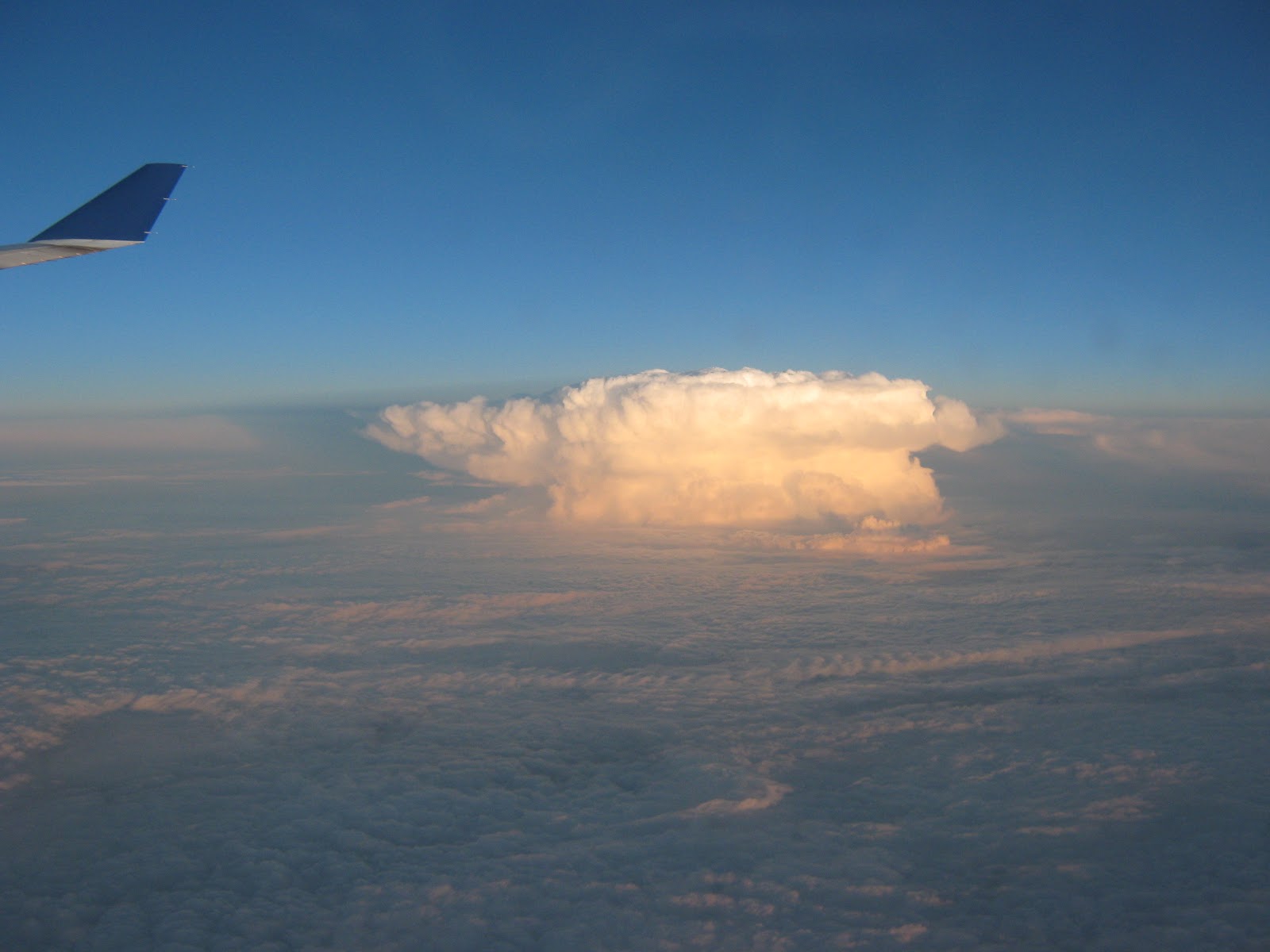 |
| thunderhead |
 |
| Note the field of wind turbines off the coast. |

 |
| Totally a land of water |

 Bill managed to find me right off and gave me my first lessons in cycling in the Netherlands. It started raining as soon as we left the airport and never stopped, though at least it was about 60 or 65 degrees.
There are roads where the two way car traffic gets only one lane and the cyclists get two. And the cars have to wait if there is not room for all to pass. The drivers scare me sometimes, because they are forced to pass so close, but they are used to it and there is no maliciousness.
Flying overhead it had looked like there were pastures without fences, ditches serving that purpose and while cycling around, it was clear that the ditches are quite effective for that purpose.
Arriving in Utecht was an eye opener, since the first sight you come across is the red light district. Little rooms perched on the edge of the canal, about two in a space equivalent to a shipping container, the women show their wares through picture windows with red neon down the sides. They all had on bras and underwear and weren't terribly risqué, but most were talking or looking at their phones. It is unclear whether they are engaged in sex chat or talking to friends or just surfing. Just a little further down the canal, beautiful canal/house boats line the edges. We have seen several windmills already. It appears there are only 900 left, but they are heavily protected. It is supposed to be as difficult to run them as to pilot a ship.
We arrived in Utrecht quite soaked and searched for the hostel and then a specific hotel, but finally gave up in exasperation and took a pretty pricy hotel. We dried our clothes on the heating registers successfully. Utech isn't especially lovely downtown, mostly owing to the massive railway station construction going on, the rest owing to the rain and grey. Thousands of bicycles are parked on every permissible surface.
Bill managed to find me right off and gave me my first lessons in cycling in the Netherlands. It started raining as soon as we left the airport and never stopped, though at least it was about 60 or 65 degrees.
There are roads where the two way car traffic gets only one lane and the cyclists get two. And the cars have to wait if there is not room for all to pass. The drivers scare me sometimes, because they are forced to pass so close, but they are used to it and there is no maliciousness.
Flying overhead it had looked like there were pastures without fences, ditches serving that purpose and while cycling around, it was clear that the ditches are quite effective for that purpose.
Arriving in Utecht was an eye opener, since the first sight you come across is the red light district. Little rooms perched on the edge of the canal, about two in a space equivalent to a shipping container, the women show their wares through picture windows with red neon down the sides. They all had on bras and underwear and weren't terribly risqué, but most were talking or looking at their phones. It is unclear whether they are engaged in sex chat or talking to friends or just surfing. Just a little further down the canal, beautiful canal/house boats line the edges. We have seen several windmills already. It appears there are only 900 left, but they are heavily protected. It is supposed to be as difficult to run them as to pilot a ship.
We arrived in Utrecht quite soaked and searched for the hostel and then a specific hotel, but finally gave up in exasperation and took a pretty pricy hotel. We dried our clothes on the heating registers successfully. Utech isn't especially lovely downtown, mostly owing to the massive railway station construction going on, the rest owing to the rain and grey. Thousands of bicycles are parked on every permissible surface. On a separate note, Bill got 2 free pieces of luggage, though he only used one and brought his boxed bike for $50 via Icelandic air, while I only got one piece of checked luggage and had to pay $80 for my second piece (that being my bike in its suitcase). He may have gotten a better deal, depending on how much he paid for his ticket. He threw out his cardboard bike box and will buy another for the return trip (I think maybe he said he can buy it from the airline for about $25).
Subscribe to:
Posts (Atom)